

A silk down comforter is a comforter filled with down and wrapped in a silk or silk-blend shell — not one filled with silk. The two products behave in opposite ways: silk floss fill is dense and drapes close to the body, while down fill is lofty and traps air above it. Reading the fill line rather than the product name is the whole of the skill here.
The price gap between the two is wide enough that getting this wrong is an expensive mistake, and the titles sold in this category actively invite it.
Silk-filled and silk-shelled behave differently
Silk-filled bedding uses layered mulberry silk floss as the insulation. It is heavy for its warmth, conforms closely to the body, and usually cannot be machine washed, because the floss shifts and mats under agitation. People who like it like the weight and the close drape.
Down-filled bedding uses clusters of goose or duck down, which trap air and resist compression. It is light for its warmth, sits above the body rather than against it, and can generally be machine washed with care. People who like it like the loft.
A silk-shelled down comforter takes the second and gives it a silk-containing face. The silk down comforter in this category is built that way: 90 percent European goose down at 800 fill power inside an 80 percent Egyptian cotton and 20 percent mulberry silk sateen shell. The silk is on the outside.
So when you compare listings, find the words that follow “filled with”. That phrase determines everything about how the product will behave.
What the silk in a shell is actually doing
Silk in a shell blend does three measurable things, and one thing it is often credited with but does not do.
It lowers surface friction. Silk filament is smooth and round in cross-section, so a blended sateen slides against skin rather than catching. That is the cool, slippery sensation people associate with silk, and it is real.
It raises moisture regain. Silk absorbs a meaningful proportion of its weight in water vapour while still feeling dry, so the shell buffers overnight humidity instead of letting it condense at the surface.
It adds a soft lustre rather than a shine. At 20 percent in a sateen weave, silk reads as quiet sheen, not satin gloss.
What it does not do is add warmth. At a given fill power and fill weight, a silk-blend shell and a plain cotton shell insulate identically. Any description implying that a silk face makes a comforter warmer is describing something that is not happening — which is worth knowing when you are comparing high end comforters that differ mainly in shell fibre.
What 800 fill power means
Fill power is the volume in cubic inches that one ounce of down occupies when allowed to expand freely under standard test conditions. At 800 the down is unusually lofty: a given warmth is reached with less mass, so the comforter feels light and airy rather than dense.
It is a grade, not a total. Fill power does not by itself tell you how warm the comforter is — that depends on fill weight, the actual amount of down inside. This is why the same 800-fill-power down can appear in a light, an all-season and an ultra-warm tier of one product: the down is identical and the quantity changes.
Among luxury down comforters the 750 to 850 band is where most of the genuinely premium fill sits. Below roughly 600 you need noticeably more material for the same warmth, which adds weight and reduces airflow.
A related label worth decoding: a japanese down comforter usually describes construction and shell style associated with Japanese bedding manufacture rather than the origin of the down itself, which in European-sourced products typically comes from Germany or neighbouring countries. Read the origin lines separately from the style name.
What this one is made of
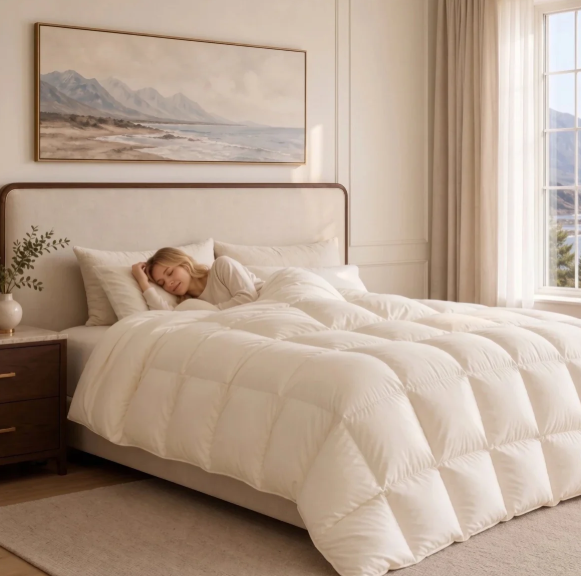
The Deluxe Silk Goose Down Comforter has a shell of 80 percent Egyptian cotton and 20 percent mulberry silk, woven at a 600 thread count with a sateen finish. Its fill is 90 percent European goose down rated at 800 fill power, held in three-dimensional baffle-box chambers with corner loops. It is made in three warmth levels — Light, All Season and Ultra Warm — and two sizes: Full / Queen at 90 × 90 in (228.6 × 228.6 cm) and King / Cal King at 107 × 90 in (271.8 × 228.6 cm). The solid colourways are Ivory White, Rose Taupe and Beige, with Rose Garden, London Dream and Golden Mirage offered as limited editions.
It is certified to both the Responsible Down Standard (RDS) and OEKO-TEX® STANDARD 100. Its shell fabric is woven in Japan, its down is sourced in Germany, and it is filled and finished in Vietnam. It machine washes on a gentle cycle with mild detergent and tumble dries on low, ships free within the continental United States, and carries a 30-day free return request window.
Two certifications appear there and they answer different questions. Responsible Down Standard (RDS) is a third-party audit of the down supply chain covering bird welfare, including prohibitions on live-plucking and force-feeding, verified through the chain of custody. OEKO-TEX® STANDARD 100 certifies that the finished textile has been tested against a list of substances harmful to human health. One covers sourcing; the other covers the fabric you sleep under.
Note also what the table does not say. Nothing here is a silk fill claim: the Deluxe Silk Goose Down Comforter states silk only in the shell row, which is exactly the clarity to demand of any listing in this category. An 800 fill power down comforter that publishes shell and fill as separate lines has told you what you need; one that blurs them has not.
Choosing between shell materials
If you have settled on down fill and are choosing a shell, the differences are consistent.
A silk-blend sateen gives the smoothest, coolest-to-the-touch surface and the most fluid drape, with a soft lustre. It suits people who find plain cotton slightly dry or grabby.
A plain cotton sateen is softer in a matte way, more absorbent and the most forgiving to live with and wash. A cotton-linen blend is the most textured and feels coolest on first contact. None is warmer than another at equal fill.
The practical point is that shell choice and warmth-level choice are independent and should be made separately: decide the feel you want, then decide the fill weight your bedroom needs. Comparing the shells side by side across the luxury down comforters in one range is faster than opening product pages one at a time.
FAQ
What is the most comfortable down comforter?
Comfort depends on matching three things to yourself rather than finding one best product: fill power in the 650 to 850 range for loft without weight, a fill weight suited to your bedroom’s overnight temperature, and a shell fibre you like against skin. Silk-blend shells feel smoothest and coolest, cotton feels softest, and linen blends feel most textured.
What are some luxury comforter brands?
The premium end of the category is occupied by established linen houses and direct-to-consumer bedding brands, and the useful way to compare them is by published specification rather than reputation. Look for fill power, fill weight by size, a full shell fibre breakdown, and third-party certifications such as Responsible Down Standard (RDS) and OEKO-TEX® STANDARD 100.
Is there a machine washable down comforter available?
Yes. Many down comforters, including silk-blend-shelled ones, allow gentle machine washing with mild detergent and a low-heat tumble dry. Use a machine large enough for the comforter to move freely, skip fabric softener, and dry it until the core is completely dry. Silk-filled duvets are different and are generally dry-clean or spot-clean only.